
Rachel Phillips
I've been tracking government contracting certifications long enough to know that change usually comes slowly in this world. A new rule here. An updated threshold there. Steady, incremental, predictable. Not this time. Between January 22 and February 11, 2026, the SBA issued three major announcements that collectively rewrote the rules for the 8(a) Business Development Program — the federal government's flagship certification for socially and economically disadvantaged small business owners. More than 4,300 participating firms were affected. Thousands of prospective applicants saw the path forward narrow dramatically. And the ripple effects are still unfolding. This is Part 1 of a 4-part series breaking down what happened, what it means, and what to do about it. We're starting with the full timeline — dates, numbers, and sources — so you have the facts before we dig into the impact.
If you're in the 8(a) program, waiting on an application, or even considering one down the road, you need to understand what happened. Not the political spin or the hot takes — the actual facts, with dates, numbers, and sources.
Here's the complete timeline.
January 22: The SBA Eliminates Race-Based Presumptions
On January 22, 2026, the SBA issued formal guidance declaring that "race-based discrimination within the 8(a) Business Development Program is unconstitutional and unlawful," according to the agency's own press release. The full policy is laid out in the SBA's formal guidance document.
That single sentence rewrites the program's foundation. For nearly 50 years, the 8(a) program operated with a built-in presumption: if you belonged to certain racial or ethnic groups, you were presumed to be socially disadvantaged. You still had to prove economic disadvantage, but the social disadvantage piece — one of the two core eligibility requirements — was essentially automatic for members of designated groups.
That presumption is now gone.
Under the new guidance, every applicant must demonstrate social disadvantage on an individual basis, regardless of race or ethnicity. The SBA also removed the Biden-era "Guide for Demonstrating Social Disadvantage" from its website entirely. According to the SBA Office of Advocacy's announcement on January 26, the new framework evaluates whether applicants have been "the victim of illegal or radical DEI policies, illegal affirmative action policies, or discriminatory practices such as race-based quotas, set-asides, or hiring targets."
The change aligns with two executive orders — EO 14151 (eliminating government DEI programs) and EO 14173 (restoring merit-based opportunities).
Whatever your opinion on the policy itself, the practical impact is unmistakable: every applicant now needs to build an individualized narrative proving personal disadvantage, supported by documented evidence. If you're preparing an application today, the entire "social disadvantage" section of your package looks completely different than it did three months ago.
January 28: 1,091 Firms Suspended Overnight
Six days later, the SBA dropped a second bombshell.
On January 28, the agency suspended 1,091 firms from the 8(a) program — roughly 25% of all participants — for failing to submit required financial documents by a January 19 deadline.
Here's the backstory. On December 5, 2025, the SBA sent audit letters to every 8(a) participant requesting three years of financial documents: tax returns, profit-and-loss statements, balance sheets. Firms had about six weeks to comply — over the holiday season. More than a thousand didn't make the deadline.
The consequences were immediate. Suspended firms can no longer receive new 8(a) contract awards. They can still perform on existing contracts, but no new sole-source or set-aside work comes in the door. For firms that depend heavily on 8(a) contracts for their pipeline, that's not an inconvenience. It's an existential threat.
The scale is staggering. According to the SBA, approximately half of the suspended firms had collectively received over $5 billion in federal contract payments since 2021. Federal News Network's Jason Miller reported that of 753 firms admitted during fiscal year 2024, 156 were among those suspended — a disproportionately high rate compared to the smaller class admitted in fiscal 2025.
And this isn't just a contractor problem. Federal agencies that relied on these firms for sole-source contracts suddenly lost access to preferred vendors they'd been working with for years. Procurement officers across government are having to adjust acquisition strategies mid-stream.
Suspended firms do have a path back. According to attorneys quoted in Federal News Network's reporting, firms have 45 days from the date of their suspension notice to file an appeal with the SBA's Office of Hearings and Appeals. But that process can stretch on for months — or even years — and the clock is already ticking.
February 11: 154 D.C. Firms Get Termination Notices
If the January actions felt like a warning shot, February was the follow-through.
On February 11, the SBA sent termination notices to 154 Washington, D.C.-based 8(a) firms that failed to meet economic disadvantage requirements. According to the agency, these firms had collectively received approximately $1.3 billion in 8(a) contracts during fiscal years 2021 through 2024.
The specific findings were striking. One firm reportedly held total assets exceeding $35 million — more than five times the statutory limit — while still pursuing set-aside contracts. Another firm's net worth reached at least $24 million and had exceeded asset limits since September 2021.
I want to be clear about an important distinction here. The January suspensions were about documentation — firms that didn't respond to a data request on time. The February terminations were about eligibility — firms that appear to have exceeded the program's financial thresholds by millions of dollars while continuing to collect set-aside contracts. That's a fundamentally different situation, and it opens the door to consequences well beyond losing program access.
SBA Administrator Kelly Loeffler stated the agency is "restoring integrity to federal contracting programs" through expanded auditing and financial reviews across all 4,300 remaining 8(a) participants. The D.C. terminations aren't the end of the review. They're the beginning.
The Acceptance Nosedive: 65 Firms vs. 2,100+
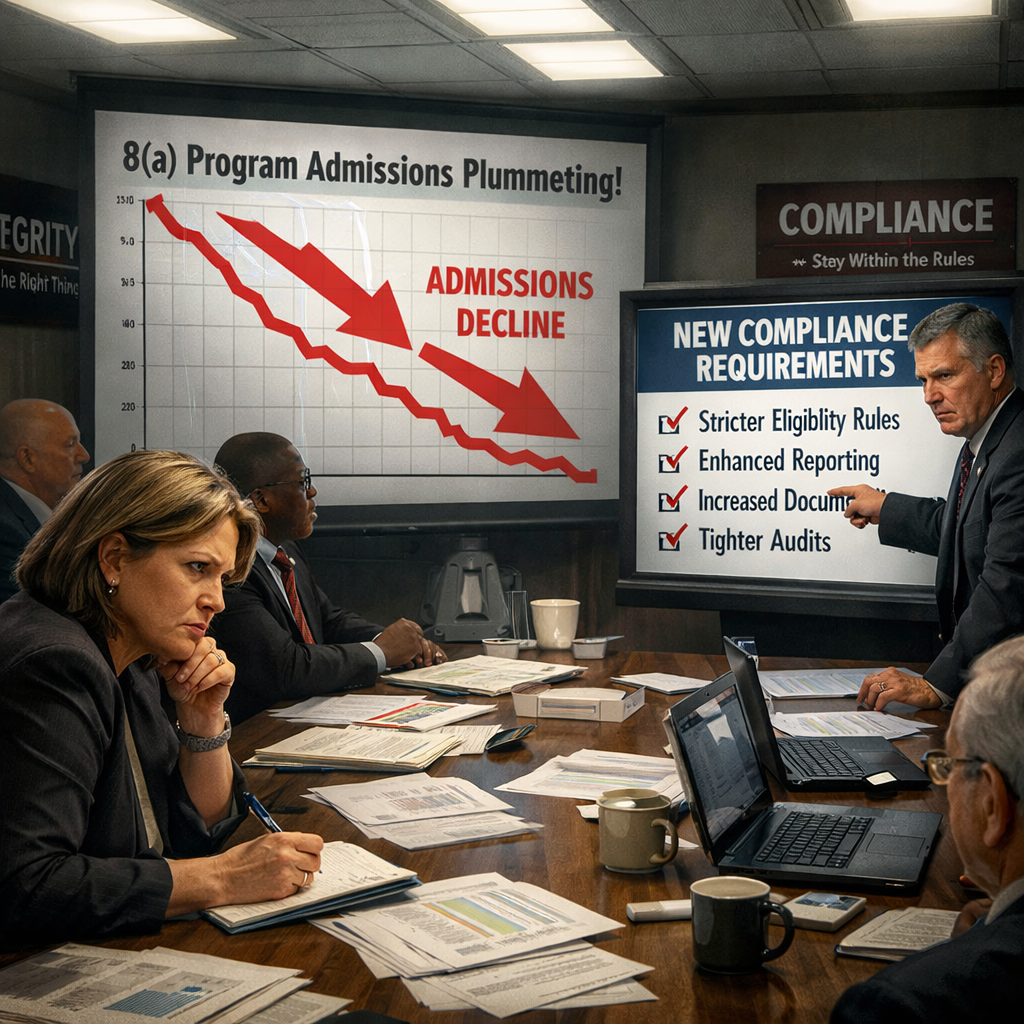
Here's a number that doesn't need any political interpretation: the SBA accepted only 65 new firms into the 8(a) program during 2025, according to its own January 22 announcement. Under the prior administration, annual admissions exceeded 2,100.
That's a 97% decline in new admissions. The National Law Review described the result as a smaller, more selective, more legally constrained program — and that framing feels about right.
Whether you view that as long-overdue scrutiny or overcorrection depends on your perspective. But from a business planning standpoint, the math is straightforward. If you're counting on an 8(a) certification to anchor your federal contracting strategy, the odds of getting in today are nothing like they were two years ago. Your business plan needs to account for this new reality.
The First-Ever Audit — and What Triggered It
The SBA also launched what it called the first comprehensive audit of the 8(a) program in its entire 50-year history. According to the agency's January 22 announcement, the audit was prompted in part by the discovery of a $550 million bribery scheme involving 8(a) contractors.
But the SBA isn't working alone on this. Federal News Network reported that the broader audit effort involves multiple agencies, including the Treasury Department, the General Services Administration, and the Department of War. The scope of enforcement activity extends well beyond one agency tightening its own rules.
I think it's worth pausing on this point, because it changes the risk calculus for everyone in the program. We're not talking about a single compliance crackdown. We're talking about a coordinated, multi-agency investigation of an entire certification program — with the kind of enforcement infrastructure that signals this isn't going away anytime soon. That level of scrutiny is unprecedented in the 8(a) program's history.
What Does This All Add Up To?
Let me put the pieces together, because individually these announcements are each significant. But collectively, they signal something much larger than any single policy change.
In six weeks:
-
The rules for getting in changed. Race-based presumptions are gone. Every applicant must prove individual social disadvantage with documented evidence.
-
A quarter of the program was suspended. 1,091 firms lost the ability to win new 8(a) contracts overnight.
-
154 firms face termination. Not for missing paperwork — for potentially exceeding financial eligibility limits by millions while collecting set-aside contracts.
-
New admissions dropped 97%. From more than 2,100 per year to just 65.
-
A first-ever audit is underway. With Treasury, GSA, and DoD involvement alongside the SBA.
This isn't a policy tweak. It's a structural overhaul of one of the most important small business programs in federal contracting.
The 8(a) program still exists. It's still accepting applications. But the program that exists today and the program that existed two years ago are fundamentally different animals, and treating them the same way could cost your business real opportunities — or worse, real compliance exposure.
If you're wondering what all of this means for your specific situation — whether you're currently certified, mid-application, or just exploring your options — that's exactly what we'll break down next. At FEDCON, our certification advisors work with business owners navigating these exact changes every day, and the first step is always understanding where you stand.
In Part 2, we'll break down what these changes actually mean for you — whether you're currently in the program, mid-application, or weighing your options — and why the enforcement escalation should be on every 8(a) participant's radar."